Rolfing® Structural Integration: A Practical Guide to the 10-Series
A "journey through the body" in ten steps: structure, themes, and integration.
🇩🇪 Diesen Artikel auf Deutsch lesen
Updated: 26 April 2026
Rolfing® Structural Integration is a hands-on, movement-informed approach that works with the body's connective tissue (often discussed as fascia) and with how you organise yourself in gravity. People often come to Rolfing® because they want to explore posture, movement efficiency, recurring tension patterns, or a sense of "not moving as freely as I used to".
Rather than promising a specific outcome, the Rolfing® Structural Integration 10-Series is best understood as a structured process: each session has a theme, and the work builds step by step. Many people start with an initial orientation session, and then decide whether a full 10-Series feels like the right next step.
The 10-Series in one sentence
A progressive series of ten sessions that explores different regions of the body, then brings them back together through integration - with the aim of supporting more options for movement, support, and ease over time. [1-3]
What you can expect (practical, client-friendly)
A mix of hands-on work and movement cues: we work with tissue quality, coordination, and everyday movement habits.
Feedback matters: pressure and pacing are adjusted to your comfort and your nervous system's response.
Change is individual: some people notice shifts quickly; others experience gradual change across the series.
Homework is optional and simple: small movement experiments, awareness cues, or recovery suggestions - not a programme you must follow.
The sessions (themes and focus)
Session 1: Freeing the breath
We start by creating more space and adaptability around the ribcage, shoulders, neck, and trunk - areas that can influence breathing mechanics and upper-body ease. Many people leave feeling more open through the chest and shoulders, and more aware of how they breathe.
Session 2: Grounding and stability
Focus on feet, lower legs, and support from the ground up. This session often explores how you load your feet, how your legs organise in standing, and what "stable" can feel like without bracing.
Session 3: The sides (space and length)
Work along the side body to support space between ribs and pelvis and to invite easier side-bending and rotation. Many people notice a sense of "more room" in the waist and ribcage.
Session 4: Core connection (inner lines)
A deeper session that often focuses on inner legs, pelvic organisation, and how the legs relate to the pelvis and trunk. The intention is not "fixing", but improving connection and support through the centre.
Session 5: Front line: psoas and diaphragm (function, not hype)
We explore the front of the trunk and hip flexor region, including the psoas area, with the aim of improving how the legs relate to the spine and pelvis in walking and standing. This can be especially relevant for people who sit a lot, train hard, or feel "pulled forward".
Session 6: Back line
Work along the back body (including the spine, sacrum area, and posterior chain) to support extension, hinge patterns, and a sense of length without rigidity.
Session 7: Head, neck, and orientation
This session often focuses on head/neck organisation and how it influences the rest of the body. Many people notice changes in balance, visual orientation, jaw/neck tension patterns, and overall coordination.
Session 8: Integration begins
From here, sessions become more integrative. We connect earlier work into coordinated movement - often focusing on either upper or lower "belts" depending on what your body needs.
Session 9: Integration continues
Refining: how do you keep the changes in real life? We often work with transitions (walking, reaching, turning) and with the "in-between" patterns that shape posture.
Session 10: Whole-body integration
A final session to consolidate the series and support a more coherent relationship between joints and movement patterns. The goal is not perfection - it is more choice, clarity, and self-trust in how you move.
Frequently asked questions (FAQ)
What is the purpose of Rolfing® Structural Integration?
To explore how your body organises in gravity and movement, and to support more efficient, adaptable patterns over time. Many people report changes in posture, ease, and body awareness - but outcomes vary. [1-3]
How does Rolfing® differ from traditional massage?
Massage often focuses on local tissue relaxation. Rolfing® Structural Integration also uses hands-on work, but places strong emphasis on whole-body organisation, movement education, and how different regions coordinate. [3]
Is Rolfing® painful?
Sensation varies. The work should be clear and effective without being overwhelming. We adjust pressure and pacing, and your feedback guides the session.
Who can benefit from Rolfing®?
People with recurring tension patterns, postural questions, athletes, desk workers, and anyone curious about improving movement options. If you have medical conditions or are unsure, we clarify suitability in advance.
Next step
If you are curious, an initial orientation session is often the simplest way to start. From there, we can decide together whether a 10-Series makes sense for your goals and your current capacity.
Rolfing® is a registered service mark of the Dr. Ida Rolf Institute® of Structural Integration. All trademarks mentioned remain the property of their respective owners.
Selected references
[1] European Rolfing Association e.V. (2023). Standards and Guidelines for Rolfing® Structural Integration Practice.
[2] Adstrum, S., Hedley, G., Schleip, R., Stecco, C., & Yucesoy, C. A. (2017). Defining the fascial system. Journal of Bodywork and Movement Therapies, 21(1), 173-177. https://doi.org/10.1016/j.jbmt.2016.11.003
[3] Zuegel, M., et al. (2018). Fascial tissue research in sports medicine: from molecules to tissue adaptation, injury and diagnostics. British Journal of Sports Medicine, 52(23), 1497-1504. https://doi.org/10.1136/bjsports-2018-099308
ABOUT THE AUTHOR
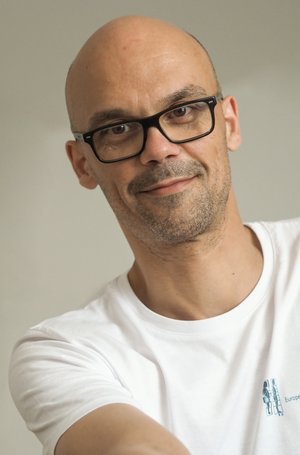
Tobias Elliott-Walter is a certified Rolfer® Structural Integration practitioner, certified ScarWork™ practitioner, and Sivananda yoga teacher based in Saarbrücken, Germany. Through Body & Beyond, he provides bilingual bodywork and health education in English and German, with a focus on fascia, movement, stress, recovery, and holistic health.
With nearly 30 years of experience working with people — across leadership development, mentoring, and international training environments in Europe, Asia, the Middle East, and North America — Tobias brings a practical, culturally sensitive perspective to bodywork. Education is central to his approach: helping people understand what their body is doing, and why, is part of the work itself.
Professional qualifications and standards
Rolfing® is a registered service mark of the Dr. Ida Rolf Institute of Structural Integration.
Sharon Wheeler’s ScarWork™ refers to the specific methodology developed by Sharon Wheeler.
All trademarks mentioned remain the property of their respective owners.
Medical and scientific statements are based on current research, professional training, and practical experience. The services and educational content offered through Body & Beyond are intended to support general wellbeing, body awareness, and health education. They are not a substitute for medical diagnosis, treatment, or psychotherapy.
Important note
This article is for information purposes only and does not replace medical advice. The information shared here is based on current scientific research and practical experience. If you have any health complaints, please consult your doctor or therapist.
© 2025 Tobias Elliott-Walter. All rights reserved.